 Squillion Game
Original Squillion guide
How to play Squillion
Start with Today’s Tree if you want the same seven prompts as a friend. Pick Free Climb for another solo run whenever you have a few minutes.
Play Squillion on the homepage
Choose a climb
Today’s Tree gives players the same seven prompts for that day, so friends can compare results even when they play at different times. Free Climb draws from a larger library and is the better place to practice how the game reacts to your guesses. Both use the same scoring rules.
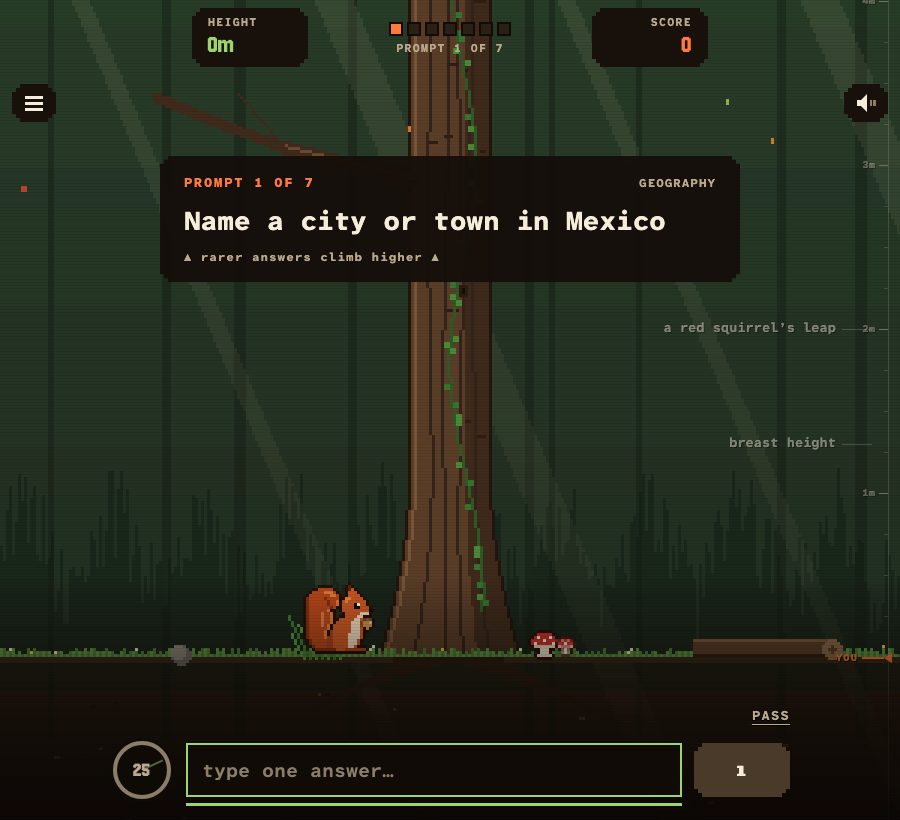
Original Squillion, Today’s Tree. The prompt counter and score sit above the answer field. Prompts rotate.
Play your first round
- Read the exact prompt during the short preview. A category like geography tells you the subject, while the full prompt defines what counts.
- Once the 25-second timer starts, type one answer. Submit it with Enter or Climb. If the game cannot match it, use the remaining time to try another answer.
- The first accepted answer ends the round. Read the game’s matched answer, rarity tier, and points before moving on. A pass or a timeout earns zero for that round.
- At the end of the seventh prompt, compare your total height, and share your result without giving away a prompt answer.
What counts as an answer
The game shows the answer it matched when it accepts a guess. If two names are plausible, add the detail that identifies the one you mean where the prompt calls for it. Use the spelling you know and read back what the game matched. A nickname or spelling variant might not count, so keep a second candidate in mind.
If you see Not on file, look at what the prompt asks you to name. A mountain range can fit the subject of a geography question while failing a request for one peak. If you spot a typo, correct it while the clock is still running. If you chose the wrong kind of answer or have little time left, switch to a different candidate. The scoring guide’s retry example shows what an open answer field looks like after a rejection. If you’re stuck in Today’s Tree, find a hint for your tree number and open only the round you need.
How to pick a first guess
Name three candidates in your head and use the most unusual one you can confidently spell and place inside the prompt’s scope. Keep the most obvious candidate in reserve if time is tight. For a city prompt, check that your answer is an actual city in the requested country before sacrificing time to chase something obscure.
What a full seven-question climb looks like
The same sequence repeats on each prompt. Use the preview to identify what counts, then use the 25-second answer window to submit. Compare any rejection with the wording of the prompt before deciding whether to correct the guess or try another. Once the game accepts an answer, read the reveal and move on. If you pass or run out of time, the following prompt still gives you a fresh chance to add height.
After seven prompts, look at your accepted answers and your total height. Imagine you land three Leaf Litter answers, two Scurry answers, one Rare answer, and one Out on a Limb answer. That’s seven accepted guesses and 235 points, or 23.5 metres. A different set of seven accepted answers can score much higher or lower. Use the six rarity tiers to see where those jumps come from.
On a first Free Climb run, see how many answers you can get accepted. On the next run, try spending a little more time on one category you know well and check whether that earns a bigger jump. In Today’s Tree, compare heights with a friend after both of you finish. You can talk about which questions took the longest without spoiling the answers for anyone who still wants to play.
See the multiplayer guide when you want to play at the same time as a friend.